⚡ Can You Solve These?
Question 1
PSLE 2021 · Mathematics Paper 2 · Question 15
Helen & Ivan Coin Problem
Ivan and Helen have an equal number of coins.
Ivan has 104 20-cent coins and some 50-cent coins.
Helen has 64 20-cent coins and some 50-cent coins.
The total mass of Helen's coins is 1.134kg.
Part (a)
Who has a higher value of coins? How much more money is the value of that person's coins?
Who has more money?
By how much? (in dollars)
Cancel & Compare (Difference) Method
Key Insight: Since Helen and Ivan have the same total number of coins, matching coins cancel each other out in value. We focus only on the value difference caused by the extra coins.
Step 1 — Find the difference in coin type:
104 (Ivan's 20¢) − 64 (Helen's 20¢) = 40 coins
Ivan has 40 more 20¢ coins than Helen. Since both have the same total, Helen MUST have 40 more 50¢ coins than Ivan.
104 (Ivan's 20¢) − 64 (Helen's 20¢) = 40 coins
Ivan has 40 more 20¢ coins than Helen. Since both have the same total, Helen MUST have 40 more 50¢ coins than Ivan.
Cancellation Principle: The remaining coins (the matching quantities) are the same for both — their values cancel out. We only compare the extra coins.
Step 2 — Compare the value of extra coins:
Helen's 40 extra 50¢ coins → 40 × $0.50 = $20
Ivan's 40 extra 20¢ coins → 40 × $0.20 = $8
Helen's 40 extra 50¢ coins → 40 × $0.50 = $20
Ivan's 40 extra 20¢ coins → 40 × $0.20 = $8
Step 3 — Find the difference: $20 − $8 = $12
✅ Helen has $12 more than Ivan.
Part (b)
If each 50-cent coin weighs 2.7 grams more than a 20-cent coin, calculate the total mass of Ivan's coins in kilograms.
Cancel & Compare (Difference) Method — Mass
From Part (a): Helen has 40 extra 50¢ coins; Ivan has 40 extra 20¢ coins. The difference in total coin mass is caused entirely by these extra coins.
Step 1 — Find the mass difference per extra coin:
Each 50¢ coin is 2.7 g heavier than each 20¢ coin.
So each of Helen's 40 extra coins is 2.7 g heavier than each of Ivan's extra 40 coins.
Each 50¢ coin is 2.7 g heavier than each 20¢ coin.
So each of Helen's 40 extra coins is 2.7 g heavier than each of Ivan's extra 40 coins.
Step 2 — Total mass difference:
40 × 2.7 g = 108 g = 0.108 kg
Helen's total coin mass is 0.108 kg more than Ivan's.
40 × 2.7 g = 108 g = 0.108 kg
Helen's total coin mass is 0.108 kg more than Ivan's.
Step 3 — Find Ivan's total coin mass:
Ivan's mass = Helen's mass − mass difference
= 1.134 kg − 0.108 kg = 1.026 kg
Ivan's mass = Helen's mass − mass difference
= 1.134 kg − 0.108 kg = 1.026 kg
✅ Ivan's total coin mass is 1.026 kg.
Question 2
PSLE 2025 · Mathematics Paper 2 · Question 17
Three Triangles
Part (a)
What is the length of AB? (in cm)
Step-by-Step Working
Key Principles to Apply
Equilateral Principle: Equilateral triangles have three equal sides and each interior angle is 60°. All equilateral triangles are similar — same shape regardless of size.Congruence Principle: When equilateral triangles overlap, the overlapping parts share the same lengths. If two equilateral triangles are congruent (≅), all their corresponding sides and angles are identical.
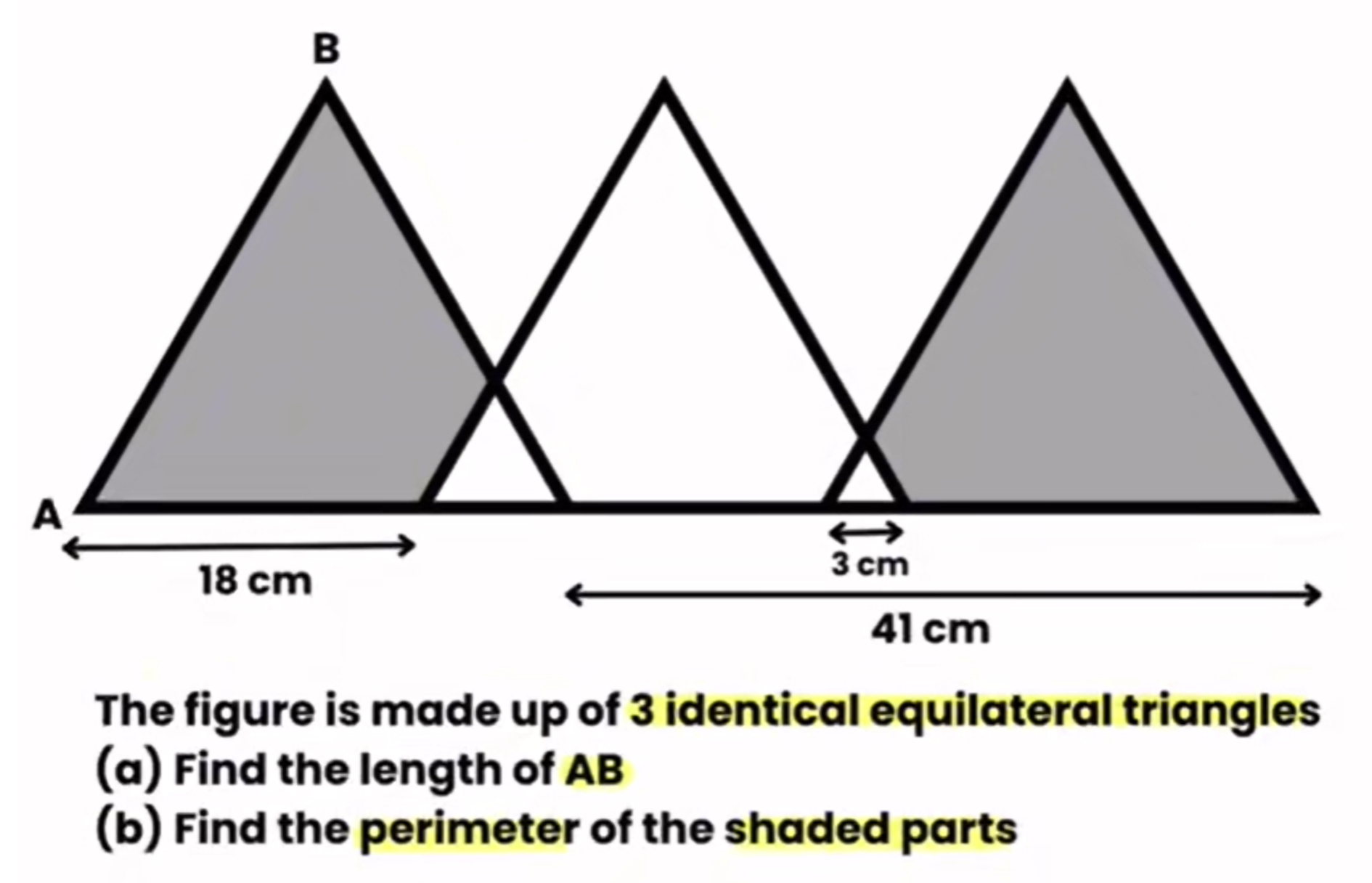
Label the vertices: Call the three equilateral triangles △ABC, △DEF and △GHI (left to right). The side lengths shown are: AD = CF = 18 cm, and GF = 3 cm. The total length from A to I is 41 cm.
Since △ABC ≅ △DEF ≅ △GHI (all three triangles are congruent):
AD = CF = 18 cm (given overlap lengths)
FI = 41 − 18 = 23 cm (remaining gap on the right)
AD = CF = 18 cm (given overlap lengths)
FI = 41 − 18 = 23 cm (remaining gap on the right)
Find GI (side of △GHI):
GI = GF + FI = 3 + 23 = 26 cm
GI = GF + FI = 3 + 23 = 26 cm
Since △ABC ≅ △GHI:
AB = GI = 26 cm
AB = GI = 26 cm
✅ AB = 26 cm
Part (b)
What is the perimeter of the shaded areas? (in cm)
Step-by-Step Working
Label the intersection points J (between △ABC and △DEF) and K (between △DEF and △GHI).
Find sides of overlapping triangle DJC (between △ABC and △DEF):
DF = AB = 26 cm (congruent triangles)
DJ = JC = DC = DF − CF = 26 − 18 = 8 cm
DF = AB = 26 cm (congruent triangles)
DJ = JC = DC = DF − CF = 26 − 18 = 8 cm
Find sides of overlapping triangle GKF (between △DEF and △GHI):
GK = KF = GF = 3 cm (given)
GK = KF = GF = 3 cm (given)
Sum the 8 outer segments of the shaded region:
AB + BJ + DJ + AD + KH + HI + FI + KF
= 26 + 18 + 8 + 18 + 23 + 26 + 23 + 3
= 145 cm
AB + BJ + DJ + AD + KH + HI + FI + KF
= 26 + 18 + 8 + 18 + 23 + 26 + 23 + 3
= 145 cm
✅ Perimeter of shaded areas = 145 cm
Question 3
PSLE 2019 · Mathematics Paper 2 · Question 17
Triangle Pattern Completion
Part (a)
How many white triangles are there in the 250th figure?
Compare and Contrast Method
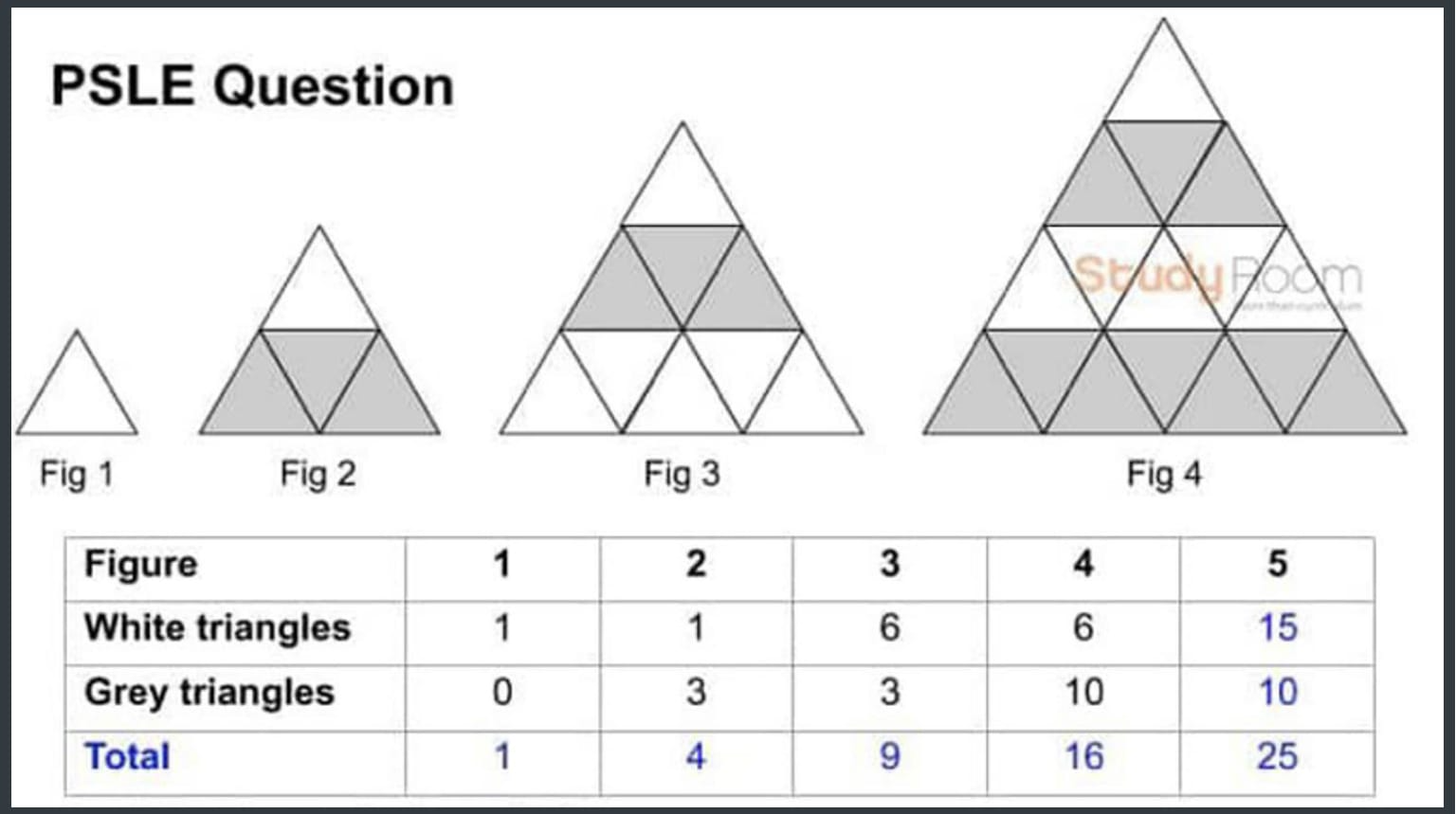
Step 1: Compare the difference between white and grey triangles in each figure
| Figure | Difference (White − Grey) |
| 1 | 1 − 0 = 1 |
| 2 | 1 − 3 = −2 |
| 3 | 6 − 3 = 3 |
| 4 | 6 − 10 = −4 |
| 5 | 15 − 10 = 5 |
Step 2: Contrast odd vs even figures
In odd-numbered figures (1, 3, 5, …), there are more white triangles than grey.
In even-numbered figures (2, 4, 6, …), there are more grey triangles than white.
Since Figure 250 is even-numbered, there will be 250 more grey triangles than white triangles.
∴ No. of grey = No. of white + 250
In odd-numbered figures (1, 3, 5, …), there are more white triangles than grey.
In even-numbered figures (2, 4, 6, …), there are more grey triangles than white.
Since Figure 250 is even-numbered, there will be 250 more grey triangles than white triangles.
∴ No. of grey = No. of white + 250
Step 3: Compute the number of white and grey triangles in Figure 250
Total = White + Grey = White + (White + 250) = 2 × White + 250
Since total triangles in Fig. 250 = 250² = 62,500
62,500 = 2 × White + 250
2 × White = 62,500 − 250 = 62,250
White = 62,250 ÷ 2 = 31,125
Total = White + Grey = White + (White + 250) = 2 × White + 250
Since total triangles in Fig. 250 = 250² = 62,500
62,500 = 2 × White + 250
2 × White = 62,500 − 250 = 62,250
White = 62,250 ÷ 2 = 31,125
✅ There are 31,125 white triangles in the 250th figure.
Part (b)
How many grey triangles are there in the 250th figure?
Compare and Contrast Method (continued from Part a)
From Part (a), we found:
White triangles in Fig. 250 = 31,125
Using the relationship: Grey = White + 250
Grey = 31,125 + 250 = 31,375
White triangles in Fig. 250 = 31,125
Using the relationship: Grey = White + 250
Grey = 31,125 + 250 = 31,375
Verify the answer:
Total = White + Grey = 31,125 + 31,375 = 62,500
Check: 250² = 62,500 ✓
Total = White + Grey = 31,125 + 31,375 = 62,500
Check: 250² = 62,500 ✓
✅ There are 31,375 grey triangles in the 250th figure.
Question 4
PSLE 2017 · Mathematics Paper 2 · Question 10
Jess's Ribbons
Jess needs 200 pieces of ribbon, each of length 110 cm, to decorate a room for a party. Ribbon is sold in rolls of 25 m each.
Answer
What is the least number of rolls of ribbon that Jess needs to buy?
Step-by-Step Working
Step 1: Convert both lengths to the same unit (centimetres).
Length of 1 piece needed = 110 cm
Length of 1 roll = 25 m = 25 × 100 = 2,500 cm
Length of 1 piece needed = 110 cm
Length of 1 roll = 25 m = 25 × 100 = 2,500 cm
Step 2: Calculate how many whole pieces can be cut from ONE roll.
Number of pieces per roll = 2,500 cm ÷ 110 cm = 22.72…
Since Jess needs complete 110 cm pieces (cannot piece together scraps), she can only get 22 full pieces per roll
(80 cm of scrap remains unused from each roll)
Number of pieces per roll = 2,500 cm ÷ 110 cm = 22.72…
Since Jess needs complete 110 cm pieces (cannot piece together scraps), she can only get 22 full pieces per roll
(80 cm of scrap remains unused from each roll)
Step 3: Calculate the total number of rolls needed.
Jess needs 200 pieces total
Number of rolls = 200 pieces ÷ 22 pieces/roll = 9.09…
Since she cannot buy a fraction of a roll, she must round up to 10 rolls
Jess needs 200 pieces total
Number of rolls = 200 pieces ÷ 22 pieces/roll = 9.09…
Since she cannot buy a fraction of a roll, she must round up to 10 rolls
Verify: 10 rolls × 22 pieces/roll = 220 pieces ✓ (exceeds the 200 needed)
Check: 9 rolls × 22 pieces/roll = 198 pieces ✗ (2 pieces short!)
Check: 9 rolls × 22 pieces/roll = 198 pieces ✗ (2 pieces short!)
✅ Jess needs to buy 10 rolls of ribbon.
⚠️ Common Trap:
If you simply calculated total length (200 × 110 = 22,000 cm = 220 m) and divided by roll size (220 ÷ 25 = 8.8 → 9 rolls), you'd get the wrong answer!
The key is that pieces cannot be pieced together from scrap. Each roll yields only 22 whole pieces, not a fractional amount.
If you simply calculated total length (200 × 110 = 22,000 cm = 220 m) and divided by roll size (220 ÷ 25 = 8.8 → 9 rolls), you'd get the wrong answer!
The key is that pieces cannot be pieced together from scrap. Each roll yields only 22 whole pieces, not a fractional amount.
Question 5
PSLE 2019 · Mathematics Paper 2 · Question 16
Overlapping Semicircles
Part (a)
What is the diameter of each semicircle?
Step-by-Step Working
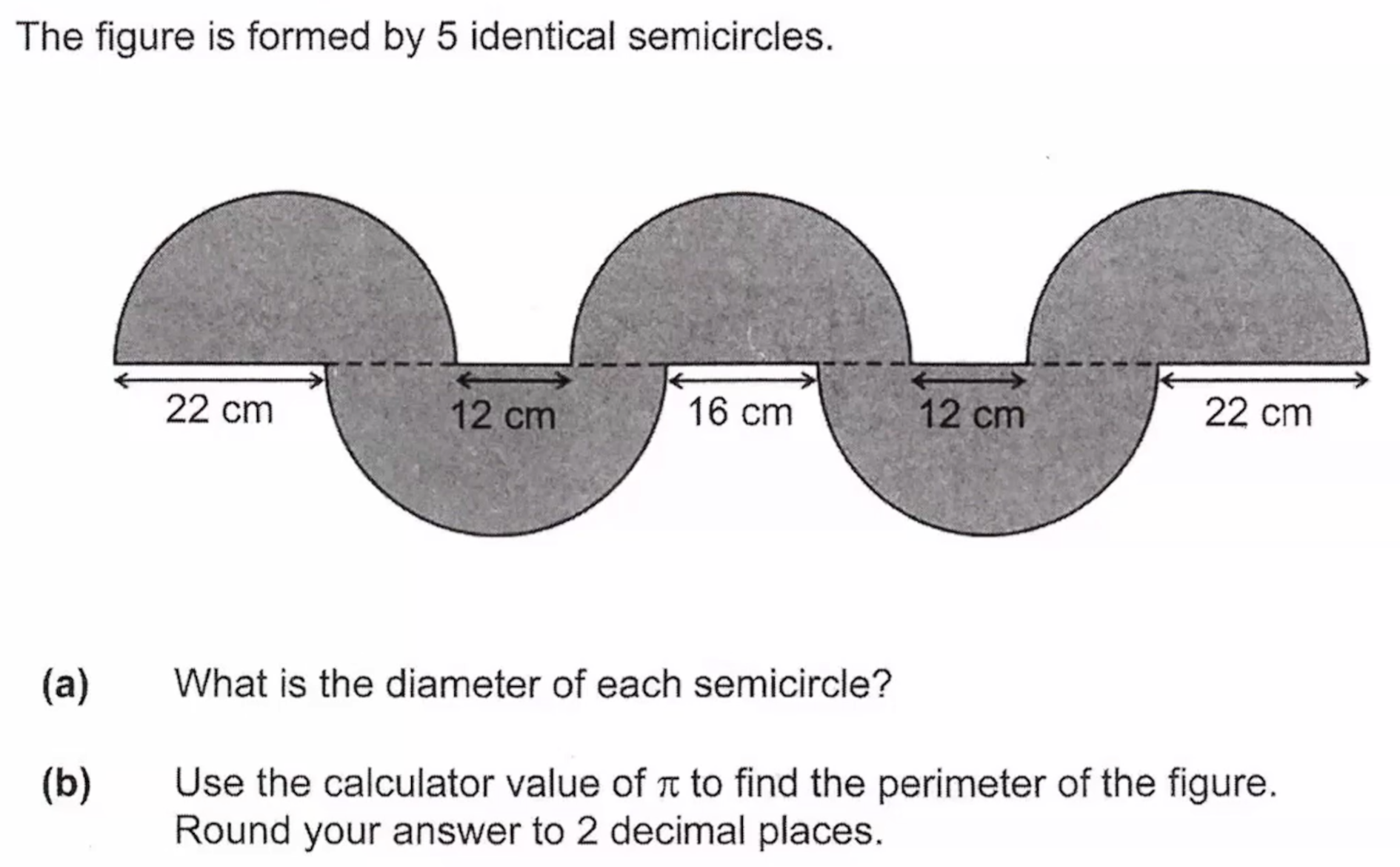
Step 1: The non-overlapped part of the first semicircle is 22 cm.
Let D = diameter, a = overlap between Semicircles 1 & 2
D − a = 22 cm
Let D = diameter, a = overlap between Semicircles 1 & 2
D − a = 22 cm
Step 2: Find the overlap between Semicircles 2 & 3.
The distance from start of Semicircle 2 to start of Semicircle 3 is 12 cm.
Let b = overlap between Semicircles 2 & 3
b = 22 cm − 12 cm = 10 cm
The distance from start of Semicircle 2 to start of Semicircle 3 is 12 cm.
Let b = overlap between Semicircles 2 & 3
b = 22 cm − 12 cm = 10 cm
Step 3: Use the middle semicircle to find the diameter.
The middle semicircle has an exposed baseline of 16 cm and overlaps by 10 cm on both left and right sides.
Diameter = 10 cm + 16 cm + 10 cm = 36 cm
The middle semicircle has an exposed baseline of 16 cm and overlaps by 10 cm on both left and right sides.
Diameter = 10 cm + 16 cm + 10 cm = 36 cm
✅ The diameter of each semicircle is 36 cm.
Part (b)
What is the perimeter of the figure? (Round to 2 decimal places)
Step-by-Step Working
Step 1: Sum all the exposed straight baseline segments.
Straight lines = 22 + 12 + 16 + 12 + 22 = 84 cm
Straight lines = 22 + 12 + 16 + 12 + 22 = 84 cm
Step 2: Calculate the total curved arc length.
The 5 semicircles combine to form 2.5 full circles.
Curved length = 2.5 × (π × 36) = 90π ≈ 282.74 cm
The 5 semicircles combine to form 2.5 full circles.
Curved length = 2.5 × (π × 36) = 90π ≈ 282.74 cm
Step 3: Add straight and curved components.
Total perimeter = 84 + 282.74 = 366.74 cm
Total perimeter = 84 + 282.74 = 366.74 cm
✅ The perimeter of the figure is 366.74 cm.